


How to Connect to the VIOFO Mobile App
Pair your phone, retrieve a clip and adjust your camera without confusing local Wi-Fi with internet access
Before you connect

The VIOFO app works with Wi-Fi-equipped VIOFO cameras. Examples include the A119M Pro, A329 series, A119 Mini 2, A129 Plus Duo and Wi-Fi-equipped A229 models. The A119 V3 has no Wi-Fi and cannot gain app connectivity through an update.
Use the app to check live view, download recordings and change the settings supported by your exact camera. Menus, available camera views, storage options and update support vary by model and app version. You do not need to leave the phone connected just to follow these setup steps again later.
Stay close to the camera for a reliable connection. Wi-Fi band support, nearby interference and your phone affect the usable range; a quoted maximum distance is not a promise of a stable download.
Watch the connection walkthrough
1. Get the official VIOFO app

Download VIOFO from Google Play or the Apple App Store. Start with the current official listing rather than an unrelated app with a similar name. Keep it up to date; phone requirements and supported features can change.
The QR graphic offers another route to the app. If scanning does not work, use the direct store links above. Download the app and any needed update while your phone has internet access, before joining the camera’s local Wi-Fi.
2. Connect your camera

Power the camera and turn on its Wi-Fi
Use the Wi-Fi control described in your camera’s manual. Some models need a press; others need a hold. On A129 models, the control uses the overlapping-squares symbol. Do not assume one button sequence applies to every VIOFO camera.
Check the camera’s Wi-Fi indicator and displayed network information, where equipped. Open the app and choose Connect New Device. Older app versions may use different wording.

Choose the model, then join its network
Select your camera and follow the app’s prompts to your phone’s Wi-Fi settings. Join the VIOFO network matching that camera. Names can include the model and a 5G prefix. The factory password is commonly 12345678; use the password shown by your camera if it has been changed.
If the phone warns that this Wi-Fi has no internet, keep the local connection. Return to VIOFO and check that the device is connected, then tap Enter Dashcam for live view. To add another camera later, use Connect Other Devices or the equivalent control in your app.
Wireless CarPlay or Android Auto may reclaim the phone’s Wi-Fi. Park safely and disconnect that wireless session before pairing with the camera. You can restore your normal phone connections when you finish.
3. Use live view and save your clips

Check the view before you drive
Live view is useful for aiming a front or rear camera, especially with a screenless model such as the VS1. Check the view while parked; do not adjust the camera or operate the app while driving.
The illustrated controls switch camera views, toggle the microphone, open settings, change the preview orientation, open the gallery, start or stop recording and take a photo. A split view or additional channel appears only when your camera and app support it. After making changes, check that recording has resumed before setting off.

Find and save a recording
Open File Management or the gallery from live view. Choose the camera’s storage location, then use the available normal, locked, parking or photo categories. A supported external drive may appear on models that record to one; it is not a feature of every VIOFO camera.
Use the date, calendar and camera-view filters to narrow the results. In the illustrated interface, dates with footage have red dots and telephoto footage is grouped under Front. GPS route information appears only when the recording contains supported GPS data.
Download the important clip to your phone, open the saved copy to check it, and keep a separate backup before deleting anything. Selection controls can handle multiple files where supported. The app’s Album or Local Album lets you access files already downloaded after you disconnect from the camera; sharing requires a suitable connection or receiving app.
4. Settings and firmware updates

Change the settings your camera supports
Open the gear icon from live view. Depending on the model, you may see resolution, bitrate, audio, loop recording, G-sensor, HDR or WDR, and parking settings. The screenshot is a menu example, not a list of settings every model has or values we recommend for every installation.
Refer to the exact camera manual before changing a setting you do not recognize. Parking recording also depends on the camera’s power arrangement and installation. An app setting alone does not supply power while the vehicle is off.

Follow the update instructions for your exact model
On supported cameras, the app can notify you about new firmware and guide you through downloading and transferring it. Internet access is needed to obtain an update; the camera’s local Wi-Fi does not provide that internet connection. Follow the app’s current prompts for the download and transfer stages.
Confirm the camera model and firmware instructions before approving an update. Keep the required power connected and do not interrupt installation or the restart. If your model does not offer OTA updates, use its official manual update process instead. The pictured A329S version is an example from the retained illustration, not the latest firmware recommendation.
If the app will not connect

Check permissions that the feature needs
On iPhone, start with Settings → VIOFO Dashcam → Local Network if the phone joins the camera’s Wi-Fi but the app cannot reach it. Photos access affects saving media. Location, Bluetooth and Wireless Data labels or prompts may also appear; follow the official guidance for your phone and the feature you are using.
Android permission names and menus vary by phone and operating-system version. Check the app’s permissions and any request to remain on a network without internet. You do not need to grant an unexplained permission simply because it is listed in an older screenshot.
The phone joins Wi-Fi, but live view stays black
- Check that the phone is still on the camera’s network, not home Wi-Fi or a wireless CarPlay/Android Auto session.
- Check Local Network access on iPhone and the relevant app permissions on Android. A VPN or phone security app can interfere; follow the official troubleshooting guidance rather than changing a managed phone’s restrictions.
- While parked, a temporary cellular-data or airplane-mode test may help isolate a connection conflict. If using airplane mode, turn Wi-Fi back on and reconnect to the camera. Restore your normal connections afterward. This is a diagnostic step, not a guaranteed fix or a requirement for every phone.
- Restart the phone and camera as their instructions allow. Check the current official app and exact-model firmware. Reinstalling the app is a later step; first preserve downloaded clips that could be removed with its data.
If it still fails, tell us the camera model, phone model, operating-system and app versions, the exact error, and whether the phone can see and join the camera network. That helps separate Wi-Fi pairing from an app or playback problem.
Other ways to review your footage
If your model has a screen, you can use its built-in playback. For a computer, shut the camera down as directed before removing its storage media, then use an appropriate reader. Some models also support USB reader mode with a suitable data-capable cable; do not assume that every supplied power cable or camera USB connection supports file transfer.
VLC is an option for general video playback on supported Windows, Mac and Linux systems. Dashcam Viewer offers additional tools for supported cameras and files, including compatible GPS data. Check its exact camera and feature compatibility rather than assuming that readable video includes telemetry support.
Find a Wi-Fi-equipped VIOFO camera
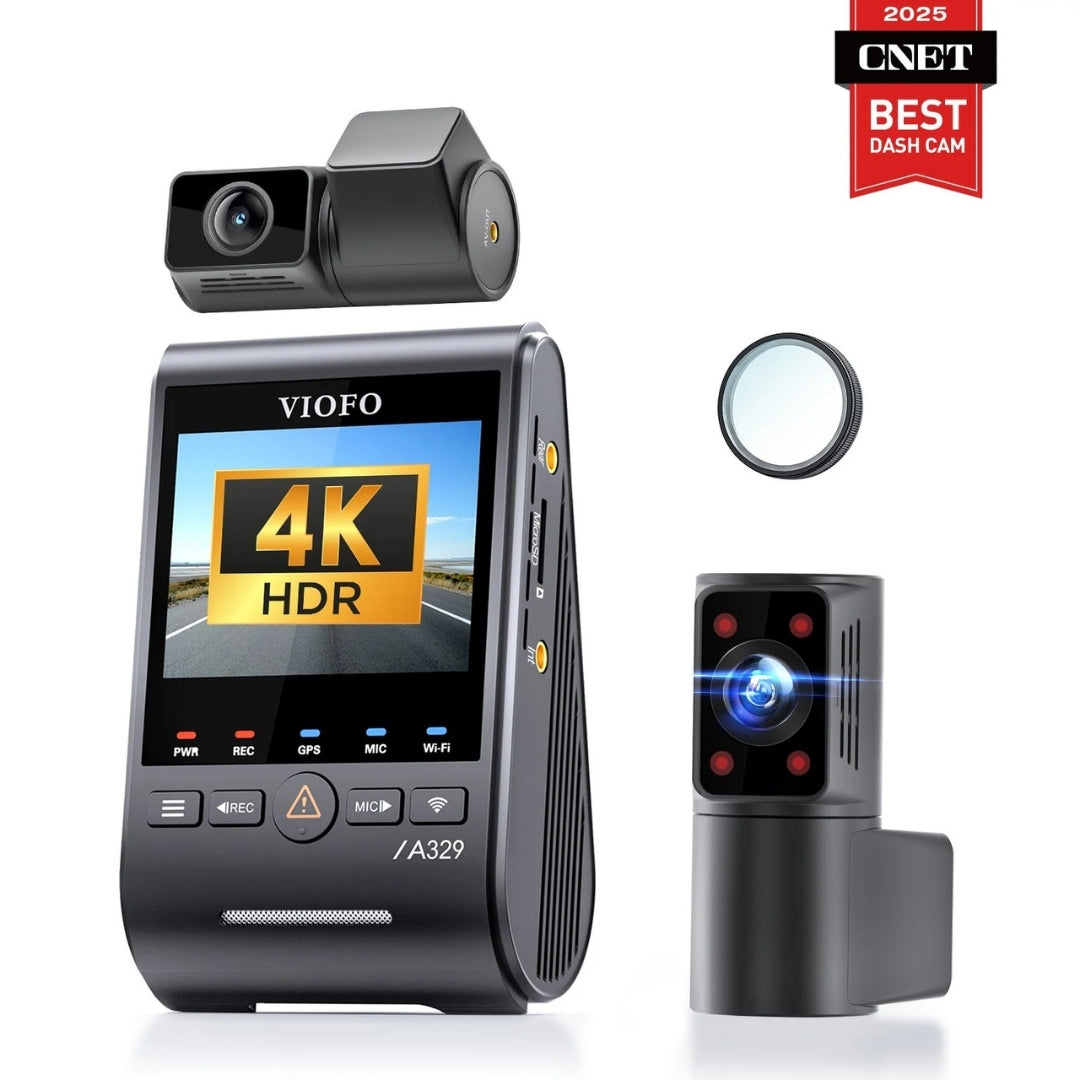
For another Wi-Fi-equipped option, see the VIOFO A329S three-channel configuration. Choose the exact configuration you need rather than using an app screenshot as a shopping compatibility list.
Our VIOFO collection helps you compare models. Check Wi-Fi and app support for the exact camera before buying; the app does not add Wi-Fi to a non-Wi-Fi model.
Ask BlackboxMyCar
We can help with a first connection, a missing clip or an unfamiliar setting. Contact our team with the details above, or browse the range when you are ready to compare.
Shop VIOFO